
NIACL AO 2025 - Descriptive English
NIACL AO 2025 — Descriptive English Course
Course Overview:
This focused preparatory course is designed for aspirants preparing the Descriptive English section of the NIACL AO 2025 Mains exam. It aims to build your ability to write precise, persuasive essays and letters in formal English under exam-conditions within tight time limits. Emphasis is on clarity of thought, language accuracy, structure, relevance, and scoring discipline.
What’s Covered:
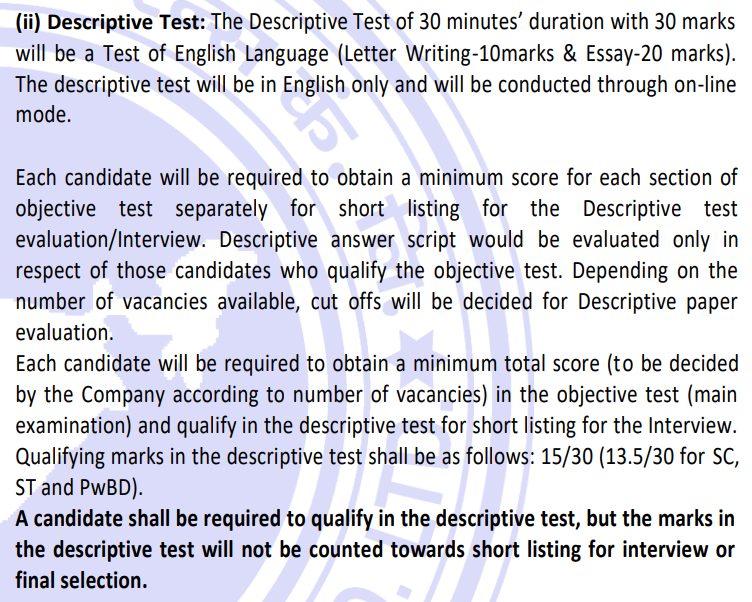
Understanding the exam format: essay letter writing, 30 marks, 30 minutes.
Types of topics & common themes for essays & letters.
Techniques for planning fast: how to brainstorm, structure, and draft without losing time.
Language tools: improving vocabulary, grammar, tone, and register needed for formal writing.
Practice with mock essays & letters under timed conditions; evaluation using NIACL-standard criteria.
Feedback loops: error correction, revision, and methods to track progress.
Why It Matters:
The Descriptive English part contributes 30 marks, and although it must be qualified by many candidates, excelling here can differentiate you.
For administrative roles, strong written communication is critical; this course builds that skill explicitly.
Regular practice under exam-style constraints helps you avoid common pitfalls (off-topic content, structural failures, grammatical errors).
Ideal For:
Candidates who have cleared the objective part (Prelims Objective Mains) and need to seal their performance with strong writing.
Those who are comfortable with English basics but need polish on formal writing, speed, and exam strategy.
Anyone aiming to raise their total score by capturing all possible marks in the descriptive test.
Lessons
- 354 lessons
-
Grammar & Vocabulary Foundation
-
Essential Grammar Refresher
-
Subject-Verb Agreement
-
Tenses (Correct Usage)
-
Articles, Prepositions, Conjunctions
-
Active vs. Passive Voice
-
Common Error Patterns
-
Vocabulary Building
-
Power Words for Essays
-
Formal & Professional Expressions for Letters
-
Transition Words for Coherence
-
Synonyms/Antonyms to Avoid Repetition
-
Module 3: Letter Writing Mastery (10 Marks)
-
Letter Format & Structure
-
Sender & Receiver Address
-
Subject Line Crafting
-
Salutation & Closing Lines
-
Body: Introduction, Content, Conclusion
-
Types of Letters with Examples
-
Formal Letters – Complaint, Request, Inquiry, Recommendation
-
Semi-Formal Letters – Editor, Society, Public Authority
-
Language & Tone – Professional, Polite, Precise
-
Model Letters (Solved Examples)
-
Practice Section: Model Letter Exercises
-
Essay Writing Mastery (20 Marks)
-
Essay Structure
-
Introduction Techniques – Hook, Quote, Data
-
Body: Logical Sequencing & Use of Examples
-
Conclusion: Summarizing & Providing a Takeaway
-
Essay Types
-
Current Affairs & Economy
-
Insurance & Financial Awareness
-
Social Issues & Ethics
-
Technology & Innovation
-
Word Limit Strategy (250–300 Words)
-
Common Mistakes to Avoid (and What to Do Instead)
-
Model Essays (High-Scoring Samples)
-
Introduction – Govt vision & IRDAI goal
-
Current Status – Insurance penetration, global comparison
-
Key Challenges – Low awareness, rural outreach, affordability
-
Policy & Industry Initiatives – Bima Sugam, digital push
-
Way Forward – Financial literacy, product innovation, regulatory support
-
Model Essay - India’s Vision 2047 – Insurance for All: Roadmap & Challenges
-
Essay Outline - India’s Vision 2047 – Insurance for All: Roadmap & Challenges
- Essay Mock 1
-
Background & Rationale - Ayushman Bharat
-
What PM-JAY is (at a glance)
-
Recent Expansions & Updates (2024–25): What Changed, Who Benefits
-
Digital Health Ecosystem under Ayushman Bharat — In-depth Overview (with latest updates)
-
Financing, Sustainability & Government Role
-
Targeting & eligibility frictions
-
Way Forward (2025–27): Innovation & Policy Recommendations
-
Essay Outline - Ayushman Bharat & Health Insurance: Expanding the Safety Net
-
Model Essay - Ayushman Bharat & Health Insurance: Expanding the Safety Net
- Essay Mock 2
-
Introduction - Embedded Insurance
-
Evolution of Embedded Insurance
-
Core Benefits of Embedded Insurance
-
Technology Enablers for Embedded Insurance
-
Embedded Insurance - Recent Developments & Case Studies
-
Future Outlook & Opportunities — Embedded Insurance
-
Way Forward & Policy Recommendations (Embedded Insurance)
-
Conclusion — Embedded Insurance: The Future of Seamless Protection
-
Essay Outline – Embedded Insurance: The Future of Seamless Protection
-
Model Essay - Embedded Insurance: The Future of Seamless Protection
- Essay Mock 3
-
Introduction - Parametric Insurance: Innovative Risk Solutions
-
Concept & Working Mechanism — Parametric Insurance
-
Applications in India & Global Context
-
key Challenges & Limitations of parametric insurance
-
Way Forward & Conclusion
-
Essay Outline - Parametric Insurance: Innovative Risk Solutions
-
Model Essay - Parametric Insurance: Innovative Risk Solutions
- Essay mock 4
-
Introduction - Bancassurance & Digital Partnerships: Expanding Reach
-
Evolution of Bancassurance in India
-
Digital Transformation & Partnership Models
-
Regulatory & Policy Framework (India) — Bancassurance & Digital Partnerships
-
Recent Developments & Case Studies (India)
-
Future Outlook & Opportunities - Bancassurance and Digital Partnerships
-
Way Forward & Recommendations - Bancassurance and Digital Partnerships
-
Essay Outline - Bancassurance & Digital Partnerships: Expanding Reach
-
Model Essay - Bancassurance & Digital Partnerships: Expanding Reach
- Essay Mock 5
-
Introduction - Microinsurance
-
Historical Evolution of Microinsurance in India
-
Understanding the Protection Gap (Rural India Focus)
-
Product Design & Features - Microinsurance
-
Regulatory & Policy Framework - Microinsurance
-
Role of Technology & Innovation - Microinsurance
-
Challenges & Limitations - Microinsurance
-
Way Forward & Recommendations - Microinsurance
-
Future Outlook (2025–2030): Microinsurance for Rural India
-
Essay outline - Microinsurance
-
Model Essay - Microinsurance
- Essay Mock 6
-
Introduction — Insurance for MSMEs & Start-ups
-
Risk Landscape: What can hurt MSMEs & start-ups?
-
Core Property & Business Continuity - Insurance for MSMEs & Start-ups
-
Liability & Governance Covers (MSMEs & Start-ups)
-
Insurance for MSMEs & Start-ups
-
Claims Readiness, KPIs & Continuous Improvement
-
Essay Outline - Insurance for MSMEs and Start-ups
-
Model Essay - Insurance for MSMEs & Start-ups: Closing the Protection Gap
- Essay Mock 7
-
Introduction & Rationale - Women-Centric Insurance Products
-
Landscape & Data Snapshot (India Focus) - Women-Centric Insurance Products
-
Risk Profile of Women Across Life Stages
-
Product Design Principles for Women - Women- Centric Insurance Products
-
Distribution Models that Work (Women-Centric Insurance)
-
Pricing, Underwriting & Fairness : Women-centric Insurance Products
-
Challenges & Ethical Considerations - Women-Centric Insurance Products
-
Essay outline - Women-Centric Insurance Products
-
Model Essay: Women-Centric Insurance: Designing for Real Lives
- Essay Mock 8
-
Introduction & Context - Motor Insurance in the EV Era
-
EV Risk Landscape (vs. ICE)
-
Traditional Motor Insurance vs. EV Insurance
-
Challenges in EV Motor Insurance
-
Regulatory & Policy Environment
-
Opportunities for Insurers
-
Case Studies & Global Practices
-
Future Outlook: Motor Insurance in the EV Era
-
Way Forward & Recommendations - Motor Insurance in the EV Era
-
Conclusion: Motor Insurance in the EV Era
-
Essay outline - Motor Insurance in the EV Era
-
Model Essay - Motor Insurance in the EV Era
- Essay Mock 9
-
Introduction to Digital India Mission
-
Key Pillars (Infrastructure, Services, Digital Literacy)
-
Impact on Governance (e-Governance, Transparency, Efficiency)
-
Social Transformation (education, healthcare, rural empowerment)
-
Challenges (digital divide, cybersecurity, infrastructure gaps)
-
Case Studies (Aadhaar, UPI, DigiLocker) — In-depth Analysis + Latest Updates
-
Way Forward & Recommendations - Digital India
-
Conclusion : Digital India
-
Essay Outline - Digital India
-
Model Essay - Digital India
- Essay Mock 10
-
Introduction & Vision - Make in India and Atmanirbhar Bharat
-
Policy Measures (PLI schemes, manufacturing push)- Make in India
-
Opportunities (jobs, FDI, exports, self-reliance) - Make in India
-
Challenges in Make in India / Atmanirbhar Bharat
-
Case Studies: Electronics, Defence, and MSMEs / Start-ups
-
Global Perspective & Competitiveness - Make in India
-
Way Forward & Roadmap - Make in India
-
Essay Outline - Make in India
-
Model Essay - Make in India & Atmanirbhar Bharat: Opportunities and Challenges
- Essay mock 11
-
Introduction: Climate Change & SDG 13 (Paris Agreement in Focus)
-
Impact of Climate Change on India (Agriculture, Health, Economy)
-
India’s Commitments (Net Zero 2070, NDCs)
-
SDGs & Climate Action Linkages - Climate Change and SDGs
-
Challenges: Financing, Technology Transfer, Policy Execution
-
Case Studies (International Solar Alliance, EV push, green hydrogen)
-
Way Forward: Global Cooperation, Green Finance, and Innovation
-
Conclusion - Climate Change and SDGs
-
Essay Outline - Climate Change and SDGs
- Essay Mock 12
-
Introduction (constitutional & social perspective) - Role of women Empowerment in Nation building
-
Importance of Women Empowerment (economic, social, political)
-
Government Initiatives: Beti Bachao, Ujjwala, and Nari Shakti Vandan Adhiniyam 2023
-
Case Studies (self-help groups, women entrepreneurs, political leaders)
-
Challenges: patriarchy, wage gap & safety issues
-
Global Comparisons (Nordic models, UN SDGs)
-
Way Forward - Role of Women Empowerment in Nation building
-
Essay Outline - Role of Women Empowerment in Nation Building
-
Model Essay - Role of Women Empowerment in Nation Building
- Essay mock 13
-
Introduction: the rise of social media
-
Awareness: reach, voice, and civic participation
-
Negative Impacts (Addiction, Misinformation, Mental Health)
-
Role in Politics & Democracy (digital campaigns, fake news)
-
Case Studies: How Social Media Shapes Youth & Society
-
Challenges: Privacy, Regulation, and Echo Chambers
-
Way Forward: Media Literacy + Regulatory Balance
-
Conclusion - Impact of Social Media on Youth and Society
-
Essay outline - Impact of Social Media on Youth and Society
-
Mode Essay on - Impact of Social Media on Youth and Society
- Essay mock 14
-
Introduction (India’s youth bulge)
-
Importance of Skilling for Growth
-
Government Initiatives (Skill India, PMKVY, Apprenticeship Programmes)
-
Challenges in India’s Skill Development & Employment Generation
-
Role of Technology (AI, digital skills, online learning)
-
Case Studies: Start-up Ecosystem & IT Sector
-
Way Forward: Pathways to Strengthen Skill Development & Employment
-
Conclusion - Skill Development and employment generation
-
Essay Outline - Skill Development and Employment generation in India
-
Model Essay - Skill Development & Employment Generation in India
- Essay mock 15
-
Introduction - India's Demographic Dividend
-
Advantages of India’s Demographic Dividend
-
Risks (jobless growth, education gaps, health challenges)
-
Role of Education & Skill Development in Realizing India’s Demographic Dividend
-
Case Studies (China’s demographic window, India’s IT boom)
-
Challenges (aging population, unemployment)
-
Way Forward (investment in human capital, jobs, healthcare)
-
Conclusion - India’s Demographic Dividend: Boon or Bane?
-
Essay Outline: India’s Demographic Dividend – Boon or Bane?
-
Model Essay - India’s Demographic Dividend: Boon or Bane?
- Essay mock 16
-
Introduction: The AI Revolution and How It’s Rewriting Work
-
Opportunities (productivity, automation, healthcare, finance)
-
Challenges (job displacement, ethics, bias, security)
-
India’s AI Push (Digital India AI strategy, Startups, IIT AI projects)
-
Global Perspective (US, China, EU frameworks)
-
Case Studies (Chatbots, FinTech, Smart Manufacturing)
-
Way Forward: Reskilling, Regulation & Responsible AI
-
Conclusion - Artificial Intelligence and Future of works
- Essay mock 17
-
Introduction (urban growth trends)
-
Opportunities of Urbanization — Economic Hubs & Innovation
-
Challenges (infrastructure, traffic, pollution, inequality)
-
Smart Cities Mission – progress & shortcomings
-
Case Studies (Indore cleanliness, Surat smart transport, international best practices)
-
Way Forward (sustainability, inclusiveness, PPP)
-
Essay outline - Urbanization and Smart Cities: Challenges and Solutions
-
Model Essay - Urbanization and Smart Cities: Challenges and Solutions
- Essay mock 18
-
Introduction: Education as the Foundation of Progress
-
Role of Education in Economic Growth
-
Role of Education in Social Development
-
Government Initiatives in Education & Skill Development
-
Challenges (dropouts, digital divide, quality of education)
-
Case Studies (Kerala literacy, IIT/IIM success, global models)
-
Way Forward: Investment, EdTech, Vocational Training
-
Conclusion: Education as an Engine for Transformation
-
Essay Outline - Role of Education in Economic and Social Transformation
-
Model Essay - Role of Education in Economic and Social Transformation
- Essay mock 19
-
Letter Prompt / Real-life Context - Request for correction of policy
-
Letter Outline / Planning (key points, paragraph plan)_ Request for correction of policy
-
Vocabulary & Formal Phrase Bank _ Request for correction of policy
-
Model / Ideal Letter_Request for correction of policy
-
Weak Student Draft + Analysis (students spot errors)_Request for correction of policy
-
Common Mistakes & How to Avoid_Request for correction of policy
- Letter mock 1
-
Letter Prompt / Real-life Context _ Application for extension of EMI
-
Letter Outline / Planning (key points, paragraph plan)_Application for extension of EMI
-
Vocabulary & Formal Phrase Bank_Application for extension of EMI
-
Model / Ideal Letter_Application for extension of EMI
-
Weak Student Draft + Analysis (students spot errors)_Application for extension of EMI
-
Common Mistakes & How to Avoid_ Application for extension of EMI
- Letter mock 2
-
Letter Prompt / Real-life Context_Complaint to civic authority
-
Letter Outline / Planning (key points, paragraph plan)_ Complaint to civic authority
-
Vocabulary & Formal Phrase Bank_ Complaint to civic authority
-
Model Letter - complaint to civic authority
-
Weak Student Draft + Analysis (students spot errors)_Complaint to civic authority
-
Common Mistakes & How to Avoid_Complaint to civic authority
- Letter mock 3
-
Letter Prompt / Real-life Context_Letter to editor on cyber frauds
-
Letter outline - to editor on cyber frauds
-
Vocabulary & Formal Phrase Bank_Letter to the editor on cyber frauds
-
Model / Ideal Letter_ Letter to the editor on cyber frauds
-
Weak Student Draft + Analysis (students spot errors)_Letter to the editor on cyber frauds
-
Common Mistakes & How to Avoid_Letter to editor on cyber frauds
- Letter mock 4
-
Letter Prompt / Real-life Context_Suggestion to improve customer service
-
Letter outline - Suggestion to improve customer service
-
Vocabulary & Formal Phrase Bank_Suggestion to improve customer service
-
Model Letter - Suggestion to improve customer service
-
Weak Student Draft + Analysis (students spot errors)_Suggestion for improvements in branch service
-
Common Mistakes & How to Avoid_Suggestion to improve customer service
- Letter mock 5
-
Letter Prompt / Real-life Context_Importance of health insurance
-
Letter Outline / Planning (key points, paragraph plan)_Importance of health insurance
-
Vocabulary & Formal Phrase Bank_Importance of health insurance
-
Model letter - Importance of health insurance
-
Weak Student Draft + Analysis (students spot errors)_Importance of health insurance
-
Common Mistakes & How to Avoid_Importance of health insurance
- Letter mock 6
-
Letter Prompt / Real-life Context_Advising on financial management
-
Letter outline - Advising on financial management
-
Vocabulary & Formal Phrase Bank_Advising on financial management
-
Model letter_Advising on financial management
-
Weak Student Draft + Analysis (students spot errors)_Advising on financial management
-
Common Mistakes & How to Avoid_Advising on financial management
- Letter mock 7
-
Letter Prompt / Real-life Context_Experiential letter
-
Letter Outline / Planning (key points, paragraph plan)_Experiential letter
-
Vocabulary & Formal Phrase Bank_Experiential letter
-
Model Letter_Experiential letter
-
Weak Student Draft + Analysis (students spot errors)_Experiential Letter
-
Common Mistakes & How to Avoid_Experiential Letter
- Letter mock 8
-
Letter Prompt / Real-life Context_Encouraging digital literacy
-
Letter outline - Encouraging Digital Literacy
-
Vocabulary & Formal Phrase Bank_Encouraging digital literacy
-
Model letter_encouraging digital literacy
-
Weak Student Draft + Analysis (students spot errors)_Encouraging digital literacy
-
Common Mistakes & How to Avoid Them_Encouraging digital literacy
- Letter mock 9
-
Letter Prompt / Real-Life Context_Opinion on the impact of social media
-
Letter Outline / Planning_Opinion on the impact of social media
-
Key Vocabulary / Terms_Opinion on the impact of social media
-
Model Letter - Opinion on the impact of social media
-
Weak Student Draft + Analysis (students spot errors)_Opinion on the impact of social media
-
Common Mistakes & How to Avoid Them_Opinion on the impact of social media
- Letter mock 10
NIACL AO 2025 — Descriptive English: Full Course Description
What It Is
The Descriptive English section is part of the Mains exam for the NIACL Administrative Officer (AO) recruitment.
It is used to test your ability in formal written English: clarity of thought, structure, language, coherence, grammar, and how well you can argue or express ideas in writing.
Exam Pattern & Format
Total Marks: 30 marks for the Descriptive section.
Duration: 30 minutes.
Components:
Essay writing — 20 marks
Letter writing — 10 marks
Mode: Online (type your responses in English).
When It Occurs: Immediately after the objective portion of the Mains exam.
What Examiners Look For
Your performance is judged on several interlinked dimensions. Doing well means balancing all of them—not just content, but also how you present it.
Relevance to the Task / Prompt
Do you fully address what the essay or letter demands? If there are multiple parts, did you cover them all?
Is your response on topic throughout, or do you drift?
Organisation & Structure
Is there a clear introduction, body, and conclusion for the essay?
In letter writing: proper format (salutation, body, closing etc.), suitable tone for the audience.
Logical flow: ideas should follow one another in a sequence that makes sense.
Argument & Development of Ideas
Use of relevant examples or reasoning to support points.
Depth: it's better to develop a few points well rather than many points superficially.
Insight: offering thoughtful perspectives, balancing different aspects when required.
Language & Vocabulary
Appropriate register (formal / polite / professional) especially in letters.
Variety in vocabulary: avoid repetitions, use precise and appropriate words.
Clarity: avoid overly complex wording that might confuse.
Grammar, Spelling & Mechanics
Accurate grammar (tenses, subject-verb agreement, articles etc.).
Correct punctuation, good sentence structure.
Spelling mistakes & mechanical errors reduce readability, cost marks.
Preparation Strategy
To perform well, you should build skills in all areas above. Here’s how a structured preparation can help:
Practice essays & letters regularly under timed conditions. Use varied topics so you can handle anything.
Plan before writing: spend a couple of minutes organizing your ideas, writing outlines. This avoids losing time rearranging ideas later.
Read widely: newspapers, editorials, formal letters etc. This builds vocabulary, exposes you to how arguments are made, how tone works in formal writing.
Work on grammar and expression: revising rules, doing small drills, focusing especially on frequent trouble spots (articles, prepositions, tenses, punctuation).
Review & Get Feedback: Write, then critically review your writing. Identify weaknesses (say, structure, off-topic, grammar), correct them. Also compare with good sample essays/letters.
Mock tests: Simulate exam conditions (time, typing, no distractions). After each mock, analyze which criteria you scored low on and work to improve those.
What Makes a Strong Answer
Here are hallmarks of high-scoring descriptive responses in NIACL AO Descriptive English:
Intro is strong: In essays, you open with context, state your thesis / opinion clearly. In letters, you address the recipient appropriately and indicate purpose early.
Body paragraphs are balanced: Each paragraph has a clear idea/topic sentence, relevant evidence or examples, linking back to the main point.
Conclusion wraps up: In essays: summarises your main points and restates your position or offers insight. In letters: closing remarks fulfill purpose (e.g. request, suggestion, gratitude etc.).
Tone and style consistent: Formal for formal letters; colloquial if allowed in informal letters. No switching styles mid-answer.
Few errors: Even small grammar or spelling mistakes can distract; top answers are polished.
Time management: Enough time for planning, writing, proofreading. No cutting corners or rushing toward end.
Why It Matters (How It Affects Your Overall Result)
Even though 30 marks may seem smaller compared to objective sections, good performance here can significantly boost your rank, especially when many candidates may get similar objective scores.
The Descriptive section is sometimes a filtering criterion — only those who qualify it (reach minimum marks) are considered further.
It demonstrates skills beyond raw knowledge: clarity, reasoning, communication — precisely what administrative officer roles require.