
Introduction
The SIDBI Grade A 2025 Descriptive English Paper plays a crucial role in Phase II of the exam. Unlike the objective sections that test speed and accuracy, the descriptive section evaluates a candidate’s clarity of thought, writing skills, grammar, and ability to structure ideas logically.
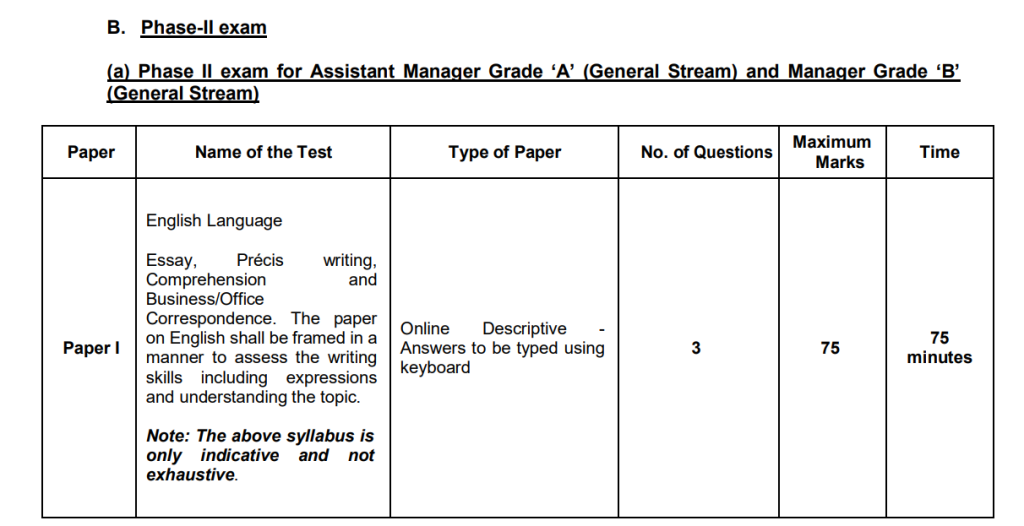
This paper consists of Essay Writing, Precis Writing, Comprehension, and Business/Office Correspondence. With 3 questions for 75 marks to be completed in 75 minutes, it requires sharp time management and practice.
In this article, we’ll break down the syllabus, paper pattern, common challenges, and preparation tips to help you master the Descriptive English paper in SIDBI Grade A 2025.
1. Exam Structure at a Glance
| Component | Details |
|---|---|
| Paper Name | English Language (Descriptive) |
| Mode | Online (to be typed using keyboard) |
| Questions | 3 |
| Maximum Marks | 75 |
| Time | 75 minutes |
| Sections | Essay, Precis, Comprehension, Business/Office Correspondence |
2. What Does Each Section Test?
2.1 Essay Writing
- Weightage: Usually 30 marks
- Purpose: Tests your ability to organize ideas, present arguments, and write with clarity.
- Topics: Social issues, economy, banking & finance, government policies, environment, and technology.
- Word Limit: 250–300 words (expected).
Examples of Possible Topics:
- Role of MSMEs in India’s growth.
- Digital lending – opportunities and risks.
- Climate change and sustainable development.
- Inflation and monetary policy challenges.
2.2 Precis Writing
- Weightage: Around 20 marks
- Purpose: Checks ability to summarize content while retaining the essence.
- Format: Passage of ~250–300 words to be condensed to one-third.
- Skills Required: Selection of main ideas, elimination of examples, coherence, grammar.
2.3 Comprehension
- Weightage: Around 15–20 marks
- Purpose: Evaluates reading skills, inference-making, and ability to interpret tone.
- Question Types:
- Direct (factual) questions
- Inference-based questions
- Vocabulary (synonyms/antonyms from passage)
- Tone identification
2.4 Business/Office Correspondence
- Weightage: Around 15–20 marks
- Purpose: Tests professional communication skills.
- Expected Formats:
- Formal letters (to seniors, clients, regulators)
- Office memos and notices
- Drafting emails
- Official reports (short)
Examples:
- Write a letter to a customer informing about new digital banking facilities.
- Draft an office memo on punctuality and discipline.
- Compose an email seeking approval for a new project.
3. Common Mistakes Candidates Make
- Exceeding or falling short of word limits – penalized in both Essay and Precis.
- Unstructured essays – without proper intro–body–conclusion.
- Copy-pasting sentences in Precis – instead of paraphrasing.
- Superficial reading in Comprehension – leading to wrong inferences.
- Informal language in business correspondence – instead of professional tone.
- Spelling & grammatical errors – reduce impression drastically.
- Not practicing typing – losing time in the real exam.
4. How to Prepare Section-wise
4.1 Essay Writing
- Build content through newspaper reading (The Hindu, Business Standard, Mint).
- Maintain a notebook with statistics, quotes, and examples.
- Practice 3–4 essays per week.
- Stick to logical flow: Introduction → Causes/Impacts → Solutions → Conclusion.
4.2 Precis Writing
- Practice compressing newspaper editorials.
- Learn to eliminate examples and minor details.
- Always write a short, meaningful title.
- Stick to the one-third rule strictly.
4.3 Comprehension
- Practice RCs from banking/finance articles.
- Focus on tone identification (analytical, critical, descriptive).
- Write answers in short, direct sentences (not essays).
- Improve vocabulary by maintaining a daily word list.
4.4 Business/Office Correspondence
- Learn formats of letters, memos, and emails.
- Keep tone formal, concise, and polite.
- Avoid contractions and casual words (e.g., write cannot instead of can’t).
- Practice drafting on workplace-like topics: policy changes, official notices, client updates.
5. Time Management Strategy
Since you have 75 minutes for 3 questions, here’s a recommended split:
- Essay Writing: 35 minutes
- Precis Writing: 20 minutes
- Comprehension/Business Correspondence: 20 minutes
Tip: Always leave 3–4 minutes for proofreading at the end.
6. Sample Practice Framework
Here’s a weekly routine to master the descriptive section:
- Day 1–2: Write one essay (250 words).
- Day 3–4: Do one Precis exercise.
- Day 5: Solve one RC set.
- Day 6: Draft a business letter or memo.
- Day 7: Attempt a full-length mock (75 minutes).
7. Key Skills to Develop
- Typing Speed: Practice on a keyboard to reach 35–40 WPM.
- Clarity of Thought: Write simple, clear English without jargon.
- Professional Tone: For business correspondence, maintain formality.
- Proofreading Habit: Correct errors before final submission.
8. Final Tips for High Scores
- Stick to word limits.
- Use connectors (however, therefore, in conclusion).
- Keep answers structured and balanced.
- Read RBI/SIDBI-related updates for essay content.
- Practice under exam-like timed conditions.
Conclusion
The Descriptive English Paper in SIDBI Grade A 2025 is not just a test of language—it is a test of your clarity, professionalism, and ability to communicate effectively. Candidates who practice systematically, avoid common mistakes, and master time management will score high.
Remember: in a competitive exam, every mark matters. With consistent writing practice, proper structure, and professional tone, this 75-mark paper can become your strongest advantage.