
📌 Introduction
The SIDBI Grade A (Assistant Manager) and Grade B (Manager) exams are highly sought-after positions. While objective sections measure your grasp of concepts, the Descriptive English Paper (Paper I – 75 marks, 75 minutes) tests your aptitude for clear, analytical, and professional communication.
This critical test evaluates four distinct writing skills:
- Essay Writing
- Précis Writing
- Comprehension (unseen passage)
- Business/Office Correspondence (formal letter or report)
All answers must be typed online, requiring speed, precision, and clarity.
🧩 Official Syllabus Summary
As per SIDBI’s official handouts and training guides, the structure for Paper I is:
- Essay
- Précis Writing
- Comprehension
- Business/Office Correspondence
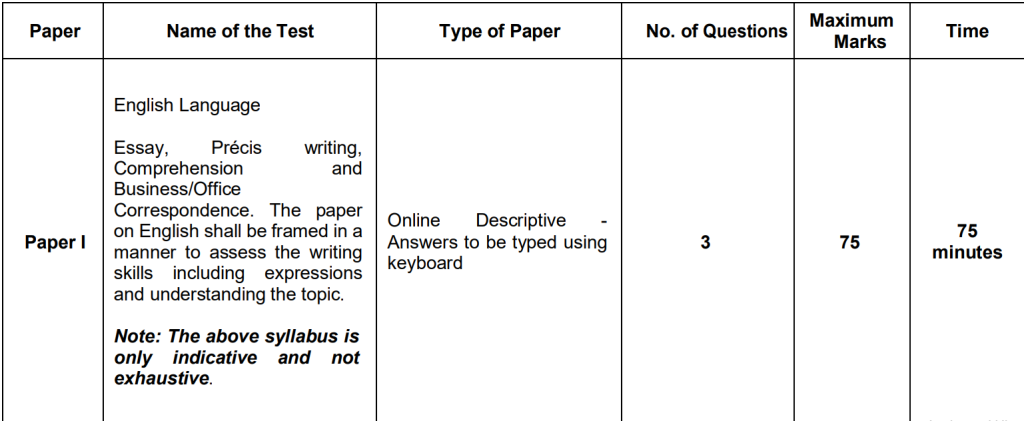
Three questions carrying a total of 75 marks, to be answered in 75 minutes, typed online .
These tasks are designed to assess your ability to reason, summarize, understand, and present ideas in a professional tone.
📅 10-Week Preparation Roadmap
Here’s a focused, full-proof prep plan to structure your time effectively:
| Week(s) | Focus Area | Key Activities |
|---|---|---|
| 1–2 | Foundation: Syllabus & Content Repository | Gather notes on economic policies, SIDBI/MSME updates, type speed (35–40 WPM) |
| 3–4 | Essay Writing | Practice 250–300-word essays with data-driven content and structure |
| 5–6 | Précis & Comprehension Skills | Summarize 300–400-word passages; practice passage comprehension |
| 7–8 | Business/Office Correspondence | Draft letters and reports in official format on MSME scenarios |
| 9 | Full-Length Mock Papers | Simulate 75-minute exams with all 4 tasks + peer feedback |
| 10 | Refinement & Polishing | Enhance vocab, templates, grammar; correct recurring mistakes |
📝 Module Breakdown
Weeks 1–2: Build Concepts & Speed
- Typing practice: Use online tests to reach 35–40 WPM
- Content bank: Compile financial stats, RBI policies, SIDBI/MSME schemes
- Trend watch: Read The Hindu/Economic Times for current affairs related to banking, economics, environment
Weeks 3–4: Essay Excellence
- Structure: Intro → 3–4 body paras → Conclusion
- Topics: Fintech impact, rural credit, green banking, COVID recovery
- Execution: 30 mins writing + 5 mins editing; include facts and stats
- Review: Assess flow, clarity, grammar, and word count
Weeks 5–6: Précis & Comprehension
- Précis: Condense 300–400 words into ~⅓ the length
- Comprehension: Practice with unseen passages; focus on:
- Main idea
- Tone and intent
- Inference-based answers
- Skills: Speed reading, note-taking, paraphrasing
Weeks 7–8: Correspondence Craft
- Formal letters: Standard formats—sender, receiver, salutation, body, closing
- Reports: Format with title, intro, findings, recommendations, conclusion
- Scenarios:
- Proposals for MSME credit schemes
- Reports on branch performance or loan recovery
- Practice: Stick to word limits; maintain tone, clarity, relevance
Week 9: Mock Exam Week
- Simulate full Paper I within 75 minutes
- Peer or mentor reviews based on:
- Task completion (4 components)
- Word count, clarity, structure, accuracy
- Typing mistakes
- Use a checklist for each script:
- Essays: structure & relevance
- Précis/comprehension: accuracy & conciseness
- Correspondence: format, tone, professionalism
Week 10: Final Polish & Revision
- Templates: Phrases for intros, transitions (“Furthermore,” “In conclusion”), formal closings
- Vocabulary list: Banking terms, idioms, synonyms
- Grammar: Use Grammarly or Write & Improve
- Speed drills: Daily practice of intros/conclusions within time
- Error correction: Track and fix common mistakes
🧭 Exam Time Allocation Strategy
Effective time management is crucial:
- Essay: 30 mins (incl. planning)
- Précis: 15 mins
- Comprehension: 15 mins
- Letter/Report: 10 mins
- Review: 5 mins
Tip: Spend the first few minutes planning each response with outlines and key points.
🚀 Key Preparation Tips
- Master typing – Clear, mistake-free 35–40 WPM needed
- Use real-world data – Add credibility with economic or SIDBI/MSME stats
- Keep language simple – Professional clarity beats ornate verbosity
- Practice frequently – Mocks and drills build speed and confidence
- Stay updated – Freshness adds impact to essays and reports
🧪 Practice Topics & Themes
- Essay: Fintech’s role in selecting lending; COVID revival through MSME credit; financial inclusion in rural India
- Précis & Comprehension: Use passages from economic surveys and editorial analysis
- Letters:
- Proposal for SIDBI-financed scheme
- Formal complaint on service delays
- Appreciation letter for branch-level improvements
- Reports:
- Analysis of MSME loan disbursement
- NPA recovery strategy for a branch